AI Business Masterclass
The Transition to Intelligent Business
Don't do the same thing, cheaper. Do more, different and better.
This is the content page: it is maintained and improved over time. Every edition of the masterclass links here. Looking for a specific delivery, with its date and venue? They are listed below.
The idea in one line
Anyone can buy the model; the advantage is the context and judgment we put on top of it. That is why the winners augment, not just automate. What makes us different makes us better.
The world
AI displaces, augments and reinvents all at once. The risk is in the transition.
The company
Augmenting is strategy, not just ethics. Context, frameworks and talent as advantage.
The professional
Portfolio career: human skills, AI fluency and the T-shaped professional.
Don't do the same thing, cheaper. Do more, different and better.
Doing the same thing more easily, faster and cheaper is a quick win within everyone's reach — and that is why it is nobody's advantage: efficiency evaporates into price. The exponential lies in reinventing: services, products, processes, even customers.
The saving of time, effort and budget is not the victory: it is the raw material. Analyze, explore and decide what you will do with that freed-up potential. Dare to change, dare to innovate — change it, but change it well.
While you analyze, plan and budget how to implement AI, your competitors have already started. And today they are not only the ones in your neighborhood: they are global — AI erases distance — and future, those not yet in your market but who will chase the same opportunities. Decide the what with judgment, but move now: build, don't prepare.
Learning objectives
What attendees take away.
- 1 Read the transition honestly — where AI displaces, augments and reinvents, and why the risk concentrates in the transition period.
- 2 Defend an augment-first strategy with business evidence (productivity, institutional knowledge, 5-year NPV), not just ethical arguments.
- 3 Identify the real competitive advantage — the context and judgment that generic AI does not bring.
- 4 Redesign the entry ramp so as not to break the talent bench (the first-job crisis).
- 5 Design a portfolio career — AI-proof skills, AI fluency and the T-shaped professional model.
- 6 Leave with actions for Monday — concrete steps for the person and for the organization.
Structure of the Masterclass
90 minutes · ~60 of presentation + conversation.
Included for participants
All attendees receive access to our AI readiness assessment tools — for companies, for executives and for professionals. Diagnose where you stand today and receive a concrete action plan.
AI as a partner, not a tool
Most people leave 80% of the value on the table: they use AI as a secretary (the same thing, faster) instead of a strategic partner. How to work with it in practice.
Three advantages no human resource has
It doesn't tire
It analyzes document 100 with the attention of document 1; it iterates 15 times without fatigue. You iterate, explore and refine as you never could with a team.
Time doesn't pass the same for it
It synthesizes in seconds what would take you weeks. 10 hours of preparation become 1.5 — and with deeper analysis. Not just faster: faster and better.
A thousand possibilities in parallel
It generates 50 alternatives at once and surfaces options that would never have occurred to you. Think in the space of possibilities, not the space of the obvious.
Seven principles
- Give it rich context (who you are, for whom, your goal).
- Don't over-constrain it: give it freedom to contribute.
- Converse, don't ask — an extended dialogue, not a transaction.
- Direct its thinking style (below).
- One-shot / few-shot when you're moving fast and with examples.
- Specify the output format.
- Ask it for clarifying questions before answering.
Five thinking styles
- Chain of thought — step by step (logic).
- Tree of thought — several branches (strategy).
- Stream of consciousness — free (creativity).
- Devil's advocate — challenges your assumptions (validate).
- Socratic method — asks you questions (clarify).
You can direct how it thinks, not just what it thinks.
Three warnings
Always verify — it hallucinates and biases; your judgment is essential (it amplifies your capacity, not your responsibility). · Don't over-delegate the strategic — AI informs the decisions; you make them. · Don't lose your voice — if everyone uses it the same way, everyone sounds the same; your perspective is the advantage.
Should we ban AI for our staff?
The short answer is no. The genie is already out of the bottle. If you ban it in the office, your people will use it on their phone or at home and copy and paste the result onto the work machines — "shadow AI": more vulnerable, not less. Banning doesn't eliminate the risk; it makes it invisible.
The full answer, with alternatives: 1) train your staff in correct use; 2) develop (or commission) your own solutions and interfaces — the leading providers commit to not use API data to train their models; 3) for the most sensitive material, run it locally (tools like LM Studio): the data doesn't leave anywhere, at the cost of more latency. The answer to AI is not prohibition: it is enablement with governance.
Enabling is not letting go
Not all AI is the same, nor is all use appropriate. The two mistakes that turn enablement into chaos — and how to avoid them.
Mistake 1 · Carelessness with data
The salesperson who, without thinking, uploads the prospect's confidential document — figures, sensitive information — to an open, public AI. There, no privacy policy will save you: the information has already left. It's exactly the risk prohibition thinks it avoids and actually makes worse.
Mistake 2 · Blank delegation
Asking AI to "write me the letter" with no context or company guidelines. The result is generic: it looks good the first time, but once you've seen three, it's obvious it came from an AI. That way you don't gain differentiation: you lose it — you make and deliver the same thing as everyone.
Enabling well has a method
1 · Train in appropriate use
"Use AI" isn't enough: what to upload and what not to, and how to prompt well.
2 · Identify the use cases
By area — sales, legal, marketing, operations. Drafting a proposal ≠ analyzing a contract.
3 · Clear guidelines and examples
Policy alone doesn't change behavior; examples do.
4 · System prompts + template library
System prompts with the company's identity, policies and guidelines embedded (so the AI responds as your company) + a library of prompt templates (dynamic or a list) that your people copy and use for each task. Factory-installed context, not improvisation.
When you embed your company's context into the very way your people use AI, risk turns into advantage — because that context is exactly what makes them different, and what makes them better. (It's exactly what we build at CEMI: bespoke solutions, system prompts and prompt libraries.)
Full material
All the Masterclass content, ready to review and share.
Takeaways (one-page summary)
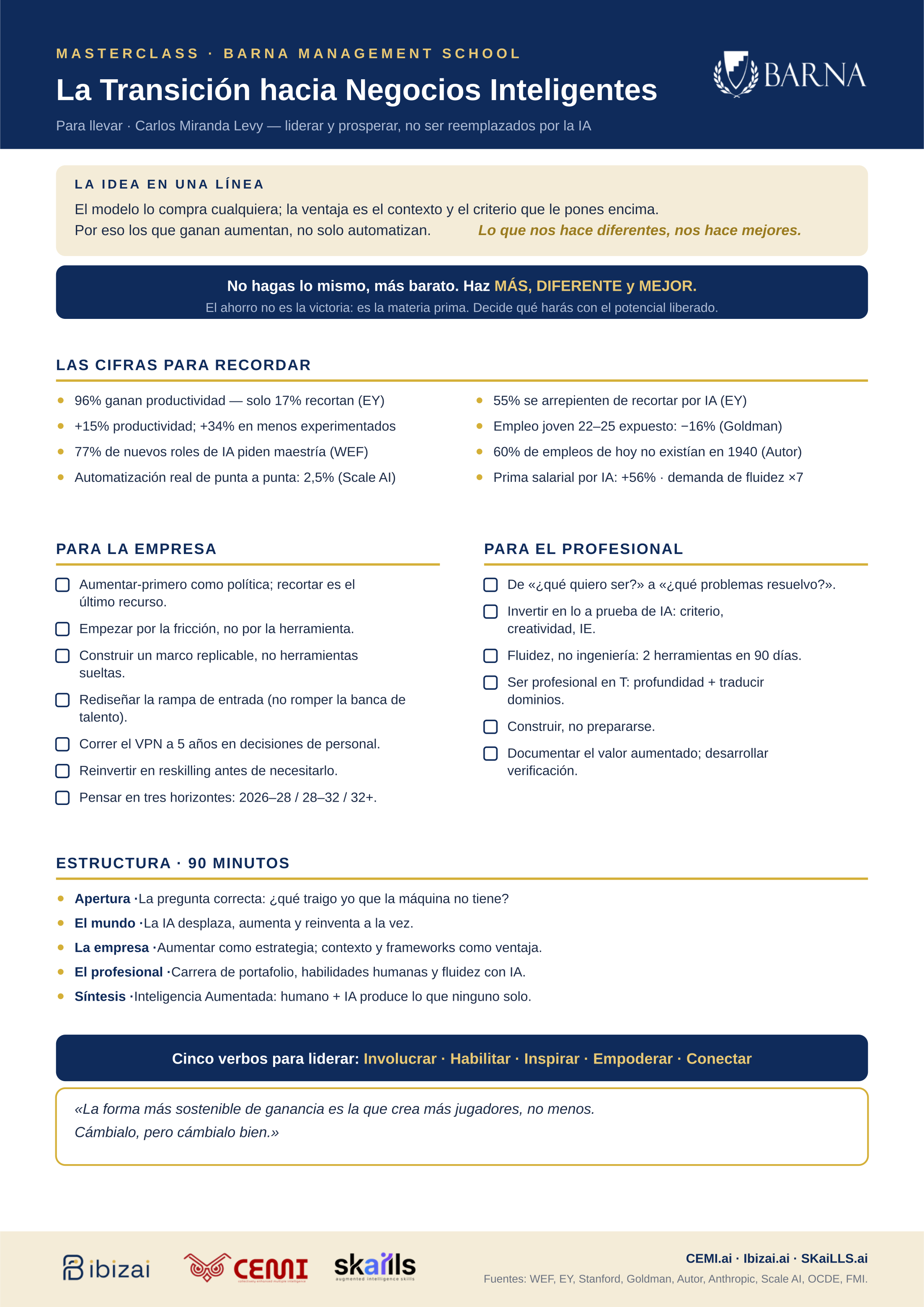
The Transition to Intelligent Business — Takeaways
Masterclass · Barna Management School — Carlos Miranda Levy (CEMI.ai) One page. The frameworks, the figures, and what to do on Monday.
The idea in one line
Anyone can buy the model; the advantage is the context and judgment you put on top of it. That is why the winners augment, not just automate. → What makes us different makes us better.
Not the same thing, cheaper → more, different and better
Doing the same thing more easily/faster/cheaper is a quick win within everyone’s reach — and that is exactly why it is nobody’s advantage: efficiency evaporates into price. The exponential lies in reinventing: services, products, processes, even customers. The saving of time, effort and budget is not the victory: it is the raw material. Analyze, explore and decide what you will do with that freed-up potential. Dare to change, dare to innovate — change it, but change it well.
The competitive clock (no alarmism)
While you analyze, plan and budget, your competitors have already started. And today they are not only the ones in your neighborhood: they are global (AI erases distance) and future (those who have not yet entered your market, but will chase the same opportunities). Decide the what with judgment, but move now: build, don’t prepare.
What AI does to work (all three at once)
It displaces tasks · augments people · reinvents work. The risk is not in the destination: it is in the transition.
The figures to remember
- 96% gain productivity with AI — only 17% cut staff. (EY)
- 55% of those who cut jobs because of AI regret it. (EY)
- +15% productivity, +34% for the least experienced. (Brynjolfsson, Stanford)
- Youth employment (22–25) in exposed occupations: −16%. (Goldman Sachs)
- 77% of new AI roles require a master’s degree. (WEF)
- 60% of today’s jobs did not exist in 1940. (Autor)
- Real end-to-end automation: 2.5%. (Scale AI) → humility.
- Wage premium for AI skills: +56% · demand for AI fluency ×7 in 2 years.
“The Knowledge”: nostalgia, skill or results
Since 1865, a London cabbie memorizes 25,000 streets and 320 runs within a 6-mile radius of Charing Cross — 3–4 years, with no technology — for a knowledge that TfL itself calls “encyclopedic”. And it works: their posterior hippocampus is larger (Maguire, PNAS 2000) and taxi and ambulance drivers show the lowest proportion of deaths from Alzheimer’s, 1.03% vs 1.69% average (BMJ 2024 — the authors declare it hypothesis generating, not conclusive). The business question: of those 3–4 years, how much reaches the passenger, who just wants to arrive — something GPS/Waze have solved for years? (Even the brain paid the trade-off: the anterior hippocampus shrank. Every specialization has an opportunity cost.) Not scrapping: rebalancing. Lower the encyclopedic part and reinvest in when to ignore the GPS · alternate routes and times of day · manner and problem solving · AI fluency. Your turn: are your job requirements — and your own development plan — designed for today’s customer or for the one from twenty years ago? → Audit one role this week in 3 columns: tradition · result · what AI frees up.
For the COMPANY — what to do
- Augment-first as policy: cutting is the last resort, not the first instinct.
- Start with the friction, not the tool: map processes → 1–2 high-ROI flows → measure → scale.
- Build a replicable framework, don’t buy stray tools.
- Redesign the entry ramp: human-AI apprenticeships, rotations, mentorship. Don’t break the talent bench.
- Run the 5-year NPV on every staffing decision (include the cost of lost knowledge).
- Reinvest AI gains into reskilling before you need it.
- Think in three horizons: 2026–28 (augment) · 2028–32 (the gap closes) · 2032+ (reinvention).
For the PROFESSIONAL — what to do
- Change the question: from “what do I want to be?” to “what problems do I solve?”
- Invest in what is AI-proof: critical thinking, creativity, emotional intelligence, systems thinking.
- Become fluent, not an engineer: 2 tools in your domain, producing within 90 days.
- Be a T-shaped professional: depth in one domain + breadth to translate across disciplines. Build at the intersections.
- Build, don’t prepare: you learn by doing; a certificate without application is worthless.
- Document your augmented value (“I produce X with AI in half the time”) and develop verification judgment.
AI as a partner — the practical playbook
Three advantages: it doesn’t tire (iterates without losing its edge) · time doesn’t pass the same for it (faster and deeper) · a thousand possibilities in parallel. The question: not “how do I do the same thing faster?” → “what can I do that used to be impossible?” Seven principles: 1) rich context · 2) freedom to contribute · 3) converse, don’t ask · 4) direct its thinking style · 5) one/few-shot · 6) explicit format · 7) clarifying questions before answering. Five thinking styles: Chain of thought · Tree of thought · Stream of consciousness · Devil’s advocate · Socratic method. (You can direct how it thinks, not just what.) Three warnings: always verify (it hallucinates/biases) · don’t over-delegate the strategic (AI informs, you decide) · don’t lose your voice. Five more techniques: Choose your words — anchor words (“quality of a Cannes/Oscar film”, “worthy of a Pulitzer”, “rigor of a peer-reviewed journal”) scale quality · Vibe coding — build apps/dashboards by describing them, but ask it for a “cybersecurity audit” of its own code (make it a habit) · Gap analysis — compare against best practices → shortcomings, risks, opportunities · Metaprompts — prompts that write prompts · 100+ things with AI: 100.cemi.ai/things.html (business section).
Ban AI for your staff? — NO
The genie is out of the bottle; banning it drives people to “shadow AI” (phone/home → copy-paste), more vulnerable. Alternatives: 1) train · 2) your own solutions/interfaces (providers don’t train on API data) · 3) local models (LM Studio: the data doesn’t leave, at the cost of latency). Enablement with governance, not prohibition.
Enabling is not letting go — not all AI is the same
Two mistakes: uploading sensitive prospect data to open AI · delegating blank (no context or guidelines → generic content: it looks good once, by the third time it is obviously AI → you lose differentiation). The method: 1) train in appropriate use · 2) identify use cases by area · 3) clear guidelines and examples · 4) system prompts (company identity + policies embedded) + a library of prompt templates to copy and use. Factory-installed context turns risk into advantage.
Five verbs to lead the transition
Involve · Enable · Inspire · Empower · Connect — people; don’t replace the ramps that make their growth possible.
The conviction
The best team isn’t the one with the best players, but the one that makes its players better — with tools, guidance, an enabling environment and the freedom to contribute. We are putting extraordinary intelligence into machines; the question is whether we bring an equivalent intelligence — strategic, ethical, long-term — to the decisions about the people those machines affect. Change it, but change it well.
Continue the conversation: CEMI.ai · iBIZai.ai (Intelligent Business with AI) · SKaiLLS.ai (talent and skills). Sources: WEF, EY, Stanford/Brynjolfsson, Goldman Sachs, Autor, Anthropic, Scale AI, OECD, IMF. All figures are verifiable.
Full speaker script
The Transition to Intelligent Business
How to transform people and companies to lead and thrive, not just survive or be replaced by AI
Masterclass · Barna Management School Author and speaker: Carlos Miranda Levy — Coordinator of CEMI’s Enhanced Intelligences · Founder of CEMI.ai (CEMI.ai · iBIZai.io · SKaiLLS.io) Format: modular program. 90-min core (Opening + The world + The company + The professional + Synthesis + Q&A) or an extended ~2 h version that includes Part 4 “AI as a partner” (the 3 advantages, the 7 principles, the thinking styles, the real case and the warnings). Part 4 can be delivered in full, condensed to ~8 min, or turned into a separate workshop. Language: English
Speaker script. First-person text (what I say), with slide markers
[SLIDE], approximate timings and stage notes in italics inside brackets. Every figure is cited and comes from real sources (see §Sources at the end). Framing: universal/global; the Dominican Republic and Latin America appear as a context I invoke, not as the default frame.
OPENING — The blacksmith and the automobile · (~5 min)
[SLIDE 1 — Title: "The Transition to Intelligent Business. Lead and thrive, don't be replaced." + name]
Good afternoon. Thank you, Barna, for the invitation.
I’m going to start not with a chart, but with a blacksmith.
[SLIDE 2 — Evocative image: forge / horseshoe. No text or minimal.]
My grandfather was a blacksmith. And not just any blacksmith: he was so renowned that people came from other towns, on horseback, to have him shoe their animals. His trade was skill, reputation and a line of people at the door.
Then the automobile arrived.
[pause]
I’m not going to tell you that my grandfather resisted, or that he gave up, because it’s not my place to invent that part. What I do know — and what matters to us today — is what the automobile did to his trade: it didn’t erase it overnight; it transformed it. It changed what was asked for, who asked for it, and how much it was worth.
That is exactly today’s conversation, a century later, with one difference: speed. What took my grandfather’s generation decades is taking us years.
[SLIDE 3 — The question: "Is AI going to replace us?" struck through → "What do we bring that AI does not have?"]
And that’s why I want to change the question almost everyone brings into this room. The question is not “is AI going to replace me?”. That question strips you of all agency and hands it to the machine.
The question that does matter — and it holds equally for a person and for a company — is: what do I bring that the machine does not have?
My thesis, in one line, and it’s the one that underpins everything I do: what makes us different makes us better. Anyone can buy the model. What can’t be bought is the context, the judgment and the human discernment you put on top of it. That is why the winners augment; they don’t just automate.
Over the next 60 minutes we’ll look at this from three altitudes: the world, the company and the professional. And I’ll be honest with the evidence — all of it — not the part that suits the optimist nor the part that suits the pessimist.
PART 1 — THE WORLD: The Transition of Intelligence · (~12 min)
[SLIDE 4 — Three big verbs: DISPLACES · AUGMENTS · REINVENTS]
First mistake I want to dismantle: believing that AI does one thing to work. No. It does three at once.
It displaces tasks. It augments people. And it reinvents work, creating categories that didn’t exist. And these happen simultaneously — even within a single job, even within a single day.
The public debate has split into three camps, and each camp has genuinely strong evidence. The uncomfortable, honest truth is that all three are right at the same time.
[SLIDE 5 — "Displacement is real, but concentrated"]
One: displacement is real, but concentrated. The IMF estimates that around 40% of global employment is exposed to AI. Amazon, Microsoft, Salesforce, IBM have explicitly cited AI in layoffs. And yet — this is key — aggregate labor-market data still shows no apocalypse: the Yale Budget Lab found “no discernible disruption” 33 months after ChatGPT. The pain is real, but it’s concentrated in specific places, not spread evenly.
[SLIDE 6 — "Augmentation has the strongest evidence"]
Two: augmentation is the best documented. Brynjolfsson’s study at Stanford found a 15% productivity gain with AI assistance — and the greatest benefit, up to 34%, for the least experienced workers. AI is compressing the skill gap: it gives someone junior a senior-level output.
And the figure I want you to take from this section, from the EY survey: 96% of organizations report productivity gains with AI… but only 17% cut staff. Most reinvested: in new capabilities, in cybersecurity, in R&D, in reskilling their people.
[SLIDE 7 — "Reinvention has history on its side"]
Three: reinvention has history on its side. The economist David Autor showed that 60% of today’s jobs correspond to occupations that didn’t exist in 1940. We didn’t lose work; it changed shape. Today AI roles are growing at extraordinary rates. But — and here comes the honest “but” — 77% of those new AI jobs require a master’s degree. The displaced cashier doesn’t become an AI engineer the following Monday.
[SLIDE 8 — "The risk is not in the destination. It's in the transition."]
So where is the real risk? Not in the destination. In the transition. In the period — these years — when the three dynamics collide. The question is not which camp is right. The question is: during the transition, who pays the cost?
And a sober warning before we go on, because I don’t want to sell you smoke: despite all the noise, the Scale AI index showed that the best AI agent achieved barely 2.5% end-to-end automation on real projects. AI is astonishing at isolated tasks and still clumsy in the multi-actor mess of real work. The “all of a sudden” may be years away. But sitting around waiting for it to arrive is not a strategy.
PART 2 — THE COMPANY: Augmenting as competitive strategy · (~21 min)
[SLIDE 9 — Section title: "The Company"]
Let’s drop one altitude: from the world to your company. Here I want to convince you of something that is not a moral argument, it’s a strategic one.
[SLIDE 10 — "The model is a commodity. The context is the advantage."]
Point one: the model is a commodity. The same model you use is used by your competitor, your supplier and the student at home. If your advantage is “we have AI,” you have no advantage: you hold the same key as everyone else.
Where is the advantage then? In what generic AI does not bring: the context of your industry, your data, your judgment, your relationship with the customer, your way of solving problems. What makes you different makes you better. AI turns that context into a transformative capability — but you supply the context.
[SLIDE 10B — "Not the same thing, cheaper" struck through → "More, different and better"]
And here is the most expensive mistake, the one almost everyone makes. The most common use of AI is to do the same thing — the same processes, the same products — only more easily, faster and cheaper. Yes, those are quick wins. And the problem is exactly that: because the barrier to entry for AI is so low, everyone is already doing it. Everyone’s quick win is nobody’s advantage: efficiency evaporates into price.
The key to getting exponential benefits from AI is not doing the same thing more easily, faster and cheaper — that’s linear and gets shared — but doing more, different and better. That is the real opportunity we’re being given: to reinvent ourselves. Our services, our products, our processes — even whom we serve, our customers. Optimizing is linear; reinventing is exponential — and it’s the only thing you can defend.
[SLIDE 10C — "The saving is not the victory. It's the raw material." → What will you do with the freed-up potential?]
And from here comes the most concrete action you can take today. The next time you implement — or plan to implement — AI, don’t book the saving as the victory. That effort, that time, that budget AI gives back to you are not the result: they are the raw material. The question that truly matters is: what are you going to do with that freed-up potential? Analyze it, explore it and decide deliberately — don’t let it evaporate. Reinvest that time and that budget in doing more, different and better. Because if you just pocket it, you did the same thing, cheaper… and we already know where that leads.
So aim for something better, different, new. Dare to change. Dare to innovate. You’ve just received extra resources to experiment — to play with. Use them. Change it… but change it well.
[SLIDE 10D — "While you analyze, they've already started" · the competitive clock]
And a warning — no alarmism, but with clarity. While you analyze, plan, debate and budget how to implement AI, your competitors have already started. I’m not saying it to scare you; I’m saying it so the clock doesn’t work against you.
And when I say “competitors,” beware of two perception traps. The first: today your competitors are not only the ones on your block, in your city or your country — they are from the whole world, even if you don’t see them yet. AI erases distance; someone on the other side of the planet can serve your customer without asking geography for permission.
The second: your competitors are not only today’s — they are also tomorrow’s. Those who don’t yet exist, who will enter your market and chase exactly the same opportunities you’re seeing now. The barrier to entry is low for you… and for them.
So decide with judgment what you’re going to reinvent — but decide it fast and start now. The deliberation is about the what, never an excuse for the when. The same rule that applies to people applies here: build, don’t prepare.
[SLIDE 11 — "Augment-first is NOT the soft option. It's the profitable one." + 96 / 17 / 55]
Point two: augment-first is the strategically superior play. And I have the data to defend it, not just the conviction.
Back to EY: 96% gain productivity, only 17% cut. And the figure you should have pinned up in the boardroom: 55% of the employers who made AI-driven cuts now regret it. Why? Because they optimized the quarter and lost something that doesn’t show up on the spreadsheet: institutional knowledge, morale, and the very adaptability they were going to need when the technology kept changing — which it keeps doing.
Cutting is easy to measure today and costly to pay for tomorrow. Augmenting preserves knowledge, keeps adaptability, and compounds advantage. Run the 5-year NPV on your staffing decisions, not just this quarter’s saving.
[SLIDE 12 — "Frameworks, not tools"]
Point three — and this one is personal, it’s what I’ve spent 30 years doing —: build frameworks, not collections of tools. A stray tool gets copied by anyone tomorrow. A replicable framework — a systematic way of applying AI to your process, that your people can adopt, adapt and scale — that’s an asset. My whole career has been about turning innovation into models others can repeat. For a company, the ROI isn’t in the tool of the month; it’s in the framework that outlives the tool of the month.
[SLIDE 13 — "The first-job crisis" — 16% / 77%]
Point four, and it’s the one that keeps me up at night: redesign how people begin. Goldman Sachs found that employment of 22-to-25-year-olds in AI-exposed occupations fell 16%. If AI absorbs the junior tasks — the research, the draft, the analysis, the “grunt work” — with which a professional was traditionally formed, we aren’t eliminating just jobs: we’re eliminating the learning, the mechanism by which the next generation of seniors is formed.
And since 77% of new AI roles require a master’s, two gaps open at once: the companies that adopt become more productive, while the talent bench that will sustain them tomorrow thins out. This is a five-year problem disguised as hiring efficiency. You’ll feel it when this cohort of middle managers reaches the top and discovers there’s no bench behind them.
The company that today, deliberately, designs new entry ramps — human-AI apprenticeships, rotations that expose the junior to what AI can’t do, real mentorship — will be the one with capable people when it matters.
[SLIDE 14 — Three horizons: 2026–28 / 2028–32 / 2032+]
Point five: think in three horizons, not one.
- 2026–2028 — the augmentation window. Most still use AI for efficiency within existing processes. It’s the window to build the people, the institutions and the frameworks. Whoever invests now compounds advantage.
- 2028–2032 — the capability gap closes. The pressure to automate rather than augment intensifies. Here the first-job crisis becomes visible, and it tests who invested in the previous window.
- 2032+ — reinvention takes shape. Autor’s pattern returns: new roles we don’t yet know how to name. The winners are those who treated this as a design challenge, not a crisis to survive.
[SLIDE 15 — "Emerging markets: the context advantage + Small AI"]
And a point that for this room — global, but with roots in an emerging market — is strategic, not decorative. The development gap is real: high-income countries concentrate the vast majority of models, startups and capital. But there are two truths that work in favor of whoever knows how to read them:
First, “Small AI” — mobile, low-infrastructure applications, for the devices people already have — is leapfrogging in health, education and finance. More than 40% of ChatGPT traffic already comes from middle-income countries. Second, and it’s my thesis again: in a market that the big platforms understand poorly, local context is a defensible competitive advantage. What makes you different makes you better — including against a global competitor with more capital but less context.
[SLIDE 15B — FAQ: "Should we ban AI for our staff?"]
And here’s the question almost every executive asks me: “Should we ban our staff from using AI?” The short answer is no. The genie is already out of the bottle. Your people know everything AI can do for them. If you ban it on the office computers and network, they’ll consult it on their phone or their home computer and copy and paste the result onto the work machines. Banning it doesn’t eliminate the risk: it makes it invisible. It defeats every intention of security and privacy and creates more vulnerable scenarios — that’s “shadow AI”.
The full answer, with alternatives, is this: One — train your staff in the correct use of AI. The difference between risk and advantage is training. Two — develop (or commission) your own AI solutions and interfaces. The leading providers commit, in their API and enterprise terms, to not use data sent via API to train or fine-tune their models. Your own interface gives you control, traceability and governance. Three — for the most sensitive material, run it locally. Tools like LM Studio let you run language models on your own computer, offline: the data does not leave. The cost is time — running a local model is slower — but it guarantees the information stays home.
In one line: the answer to AI is not prohibition, it’s enablement with governance.
[SLIDE 15C — "Not all AI is the same, not all use is appropriate"]
But careful: enabling is not letting go. Not all use of AI is the same, nor is all use appropriate. Let me show you the two mistakes I see again and again.
The first, carelessness with data. The salesperson who, without thinking, uploads the prospect’s confidential document — their figures, their sensitive information — to an open, public AI. There, no privacy policy will save you: the information has already left. That is the risk prohibition thinks it avoids and actually makes worse.
The second, more subtle but just as costly: blank delegation. Asking AI “write me the letter”, “prepare me the reply” with no context, no company guidelines. The result? Generic. It looks good the first time. But once you’ve seen three, it’s obvious it came from an AI — no soul, without your stamp. And watch this: that way you do not gain differentiation. You lose it. You end up doing the same thing as everyone, delivering the same thing as everyone. Exactly the opposite of what we came here to say.
[SLIDE 15D — "Enabling well has a method: train · use cases · system prompts · templates"]
That’s why enabling well has a method. Four pieces:
One — train in appropriate use. It’s not enough to say “use AI.” You have to teach what to upload and what not to, and how to prompt well. Two — identify the real use cases for each area: sales, legal, marketing, operations. AI isn’t used the same way to draft a proposal as to analyze a contract. Three — give clear guidelines and examples for each case. Policy alone doesn’t change behavior; examples do. Four — and this is what really moves the needle — give them two tools:
- System prompts: general instructions that carry embedded the identity, policies and guidelines of your company — so the AI responds as your company, not as just anyone.
- And a library of prompt templates — ideally dynamic, or at least a list — that your people copy and use for each identified task. Factory-installed context, instead of improvisation.
And here the circle closes with everything we’ve said: when you embed your company’s context into the very way your people use AI, risk turns into advantage. Because that context — your identity, your judgment, your way of solving problems — is exactly what makes you different, and what makes you better.
“The Knowledge”: nostalgia, skill or results · (~6 min)
[SLIDE — "The Knowledge"]
Let me close this part with a case that obsesses me, because it forces us to ask the most uncomfortable question about our own company.
Since 1865, to drive a black cab in London you have to pass an exam called “The Knowledge”. To pass it you must memorize some 25,000 streets and the 320 runs of the Blue Book, within a six-mile radius of Charing Cross, and recite it on demand, with no help from technology. It takes, on average, three or four years. Transport for London describes it with its own word: an “encyclopedic” knowledge.
[SLIDE — "It changes their brain"]
And before questioning anything, let’s do it justice: it works. A classic study found that London cabbies’ posterior hippocampus is larger than average — and that it grows with years in the trade. [Maguire et al., PNAS, 2000.] And in 2024, an analysis published in The BMJ covering close to nine million deaths across 443 occupations found that taxi and ambulance drivers had the lowest proportion of deaths from Alzheimer’s: 1.03% versus 1.69% for the average.
Now the mandatory honesty, because if I don’t say it, whoever googles it will: the authors themselves declare it hypothesis generating, not conclusive; it is an observational study. And the pattern does not appear in bus drivers or in pilots, nor with other dementias — which suggests that what is specific is the mental navigation, not the steering wheel.
[SLIDE — "And what does the customer get?"]
All of that is real and it is admirable. But now let’s ask the business question, with all the respect in the world for an extraordinary trade.
Take away the pride, the identity, the belonging and the mastery of the craft — which are genuinely valuable. Of those three or four years of preparation, how much actually reaches the person who gets into the cab? Because the passenger, almost always, just wants to arrive. And GPS, Waze and Google Maps have done that — well — for years.
[pause]
There is a detail in the brain study that strikes me as the best metaphor for all of this: while the posterior hippocampus grew, the anterior one shrank. Every specialization has an opportunity cost. Even biology charges it.
[SLIDE — "Nostalgia, skill or results"]
Let me be clear: I am not proposing that we scrap the exam. I am proposing that we rebalance it. Lower the weight of the encyclopedic part — the word is theirs — and reinvest that time, which is money and energy, in what actually distinguishes a great cabbie from a GPS today:
- Knowing when to ignore the GPS, and why.
- Alternate routes for an emergency; runs according to the hour, the traffic or the type of visitor.
- Manner, service, reading the passenger, problem solving.
- AI fluency for everything memory no longer has to carry.
The best of both worlds: the judgment of the trade, without the dead weight of the part technology has already solved.
And here comes the part that is on you. Are your company’s job requirements designed for today’s customer, or for the one from twenty years ago? How much of what you require in a profile is result, how much is real skill, and how much is nostalgia — a tradition that keeps being asked for because it always was? And the same question, in the first person: is your own professional development plan optimized for the world that’s coming, or for the one that trained you?
Today’s customer wants the same thing as always — to arrive — but faster, better informed, more traceable, more precise, more personalized and at a better cost. AI is today the shortest path to that.
The action, this week: take a role in your organization and split it into three columns — what you require out of tradition, what the result requires, and what AI already frees up. Whatever is left in the first column is your Knowledge: decide, with judgment, how much to keep and how much to reinvest.
PART 3 — THE PROFESSIONAL: The portfolio career · (~21 min)
[SLIDE 16 — Section title: "The Professional"]
Third altitude, and the most personal for each of you. Because you are not only executives: you are also professionals whose own work is changing.
[SLIDE 17 — Ladder struck through → network of nodes]
The ladder is over. The old script — degree, company, promotion, retirement — assumed a stable world that no longer exists. Today’s career is not a ladder you climb; it’s a network you navigate, where each node is a skill, an experience, a domain.
[SLIDE 18 — "What do I want to be?" → "What problems do I solve?"]
And that forces a change in the career-planning question. Not “what do I want to be?” — that anchors you to a job that can disappear. But “what problems do I know how to solve?” — that travels with you from one node to another, whether or not the title survives.
[SLIDE 19 — "AI-proof skills"]
What to invest in? Start with what AI does worst. The OECD framework places AI at a low level precisely in social interaction, metacognition and physical manipulation. Translated:
- Critical thinking — evaluating information and questioning conclusions (including AI’s).
- Creativity — new solutions to complex problems.
- Emotional intelligence — the most AI-proof skill of all.
- Systems thinking — understanding how the pieces connect.
- And a meta-skill: collaborating with AI — knowing how to work it, not just use it.
[SLIDE 20 — "AI fluency, not AI engineering" — 7x / +56%]
Watch this, because it gets misread: you don’t need to become AI engineers. You need to become fluent. Demand for AI fluency in job postings grew sevenfold in two years. The wage premium for AI skills reached 56%. Fluency is understanding where AI shines in your domain, where it fails, and how to work with it. That is within everyone’s reach in this room, without a PhD.
[SLIDE 21 — "The T-shaped professional"]
My favorite model for this is the T-shaped professional. The vertical stem of the T is your depth: the domain where you are genuinely good. The horizontal bar is your breadth: literacy across many disciplines, and the ability to translate between them. In a world of AI, the one who translates across domains — who connects business with data, law with product, operations with the model — is the one who becomes indispensable. Build at the intersections: supply chain + machine learning; marketing + data science.
[SLIDE 22 — "Build, don't prepare"]
And an antidote to paralysis: build, don’t prepare. Every week you spend “preparing” to use AI is a week someone else is already launching and learning by doing. Real learning happens in the execution. Pick two tools in your domain and start producing with them over the next 90 days. Don’t wait for the certificate; a certificate without application is worthless — context is king.
[SLIDE 23 — "Document your value in augmented terms"]
Two concrete moves to close this part: One, document your value in augmented terms. “I produce X with AI assistance in half the time” is the professional narrative of 2026. Stop measuring hours; measure augmented output. Two, develop verification and oversight judgment. As AI reaches 70–80% capability on structured work, the premium is no longer on producing the draft, but on validating, refining and contextualizing it. The “human in the loop” has stopped being a patch and become a professional skill with a name of its own.
PART 4 — AI AS A PARTNER: how to work with it in practice · (~18 min)
[SLIDE 24 — Section title: "AI as a partner, not a tool"]
So far we’ve talked about strategy and career. Let’s drop down to the keyboard now: how you work with AI in daily practice. Because most people are using it wrong — not technically, but they are leaving 80% of its value on the table. They use it like an efficient secretary: to do the same thing, faster. And yes, that saves time. But the real leap is using it as a strategic partner that amplifies your capacity to think.
[SLIDE 25 — "Three advantages no human resource has"]
First, understand what makes AI fundamentally different from any human collaborator. Three advantages:
One: it doesn’t tire. You, after three intense hours, on the fifth report of the day, on document number twenty, lose your edge. AI analyzes document one hundred with the same attention as the first, and iterates twenty times without fatigue or resentment. What does that mean? That you can iterate, explore and refine as you never could with a human team. A proposal you’d iterate two or three times with an assistant — so as not to wear them out — you iterate fifteen times with AI: structure, technical angle, commercial angle, refining each section… each version with full attention.
Two: time doesn’t pass the same for it. It processes in seconds what would take you weeks to read; it synthesizes patterns from hundreds of documents instantly. A strategic meeting that traditionally requires ten hours of preparation gets done in an hour and a half, and with deeper analysis. It’s not just faster. It’s faster and deeper.
Three: it thinks in parallel — a thousand possibilities at once. We think sequentially and, realistically, explore three or four options before deciding. AI generates fifty simultaneous alternatives and surfaces options that would never have occurred to you — because the best solutions are almost never the first ones; they live in the space of possibilities our brain never had time to explore. When I developed the content strategy for the “La Enorme Navidad Juguetón” campaign, instead of three concepts I asked it for thirty — by audience, by tone, by format, by Dominican cultural angle. I got thirty in two minutes. Most were no good. But three were brilliant and would never have occurred to me, and they ended up at the core of the campaign. That is thinking in the space of possibilities, not the space of the obvious.
[SLIDE 26 — "The right question changes everything"]
That’s why the right question is not “how do I do my current work faster?” but “what can I do now that used to be impossible or impractical?” An email stops being drafting and becomes a communication strategy. A presentation stops being ten slides and becomes a persuasive narrative. A data analysis stops being a summary and becomes strategic intelligence. You don’t use AI to do your work: you use it to do work better than you could alone.
[SLIDE 27 — "Seven principles for working with AI"]
How do you achieve that? Seven principles. I’ll state them quickly; they’re all in the material you’re taking home.
One — give it rich context. “Write a report on X” produces something generic, that sounds robotic, because AI doesn’t know who you are, your style, your audience or your goal. Begin every important interaction telling it who you are, whom you’re writing for, what you’re after and what sensitivities exist. AI can only be as good as the context you give it.
Two — don’t over-constrain it; give it freedom to contribute. If you dictate every word, you reduce it to a transcription machine. Give it general direction and space: “surprise me with an approach I wouldn’t have considered.”
Three — converse, don’t ask. Don’t treat it as an isolated transaction. Treat it as an extended dialogue where each round builds on the previous one: you propose, it responds, you object, it refines, you adjust for the team, it adapts, and at the end you ask for the plan. The magic happens in the extended conversation.
Four — and few people know this — direct its thinking style. You can decide how it thinks, not just what:
- Chain of thought (step by step, show me your reasoning) — logical decisions.
- Tree of thought (explore several branches at once) — strategy and scenarios.
- Stream of consciousness (think freely, without structure) — creativity, breaking patterns.
- Devil’s advocate (challenge my assumptions, find the flaws) — validating important decisions.
- Socratic method (don’t give me answers, ask me questions) — clarifying your own thinking.
Five — one-shot or few-shot when you’re moving fast. Give it an example — or two or three — of what works (“here are three of my posts with good engagement; capture my style and write five more”). Examples give it your voice in action. It only works if you truly know what you want.
Six — specify the format. Don’t leave it to guess: one-page executive report, metrics table, technical memo, brief email, five-slide presentation. The same content, in the format each audience needs.
Seven — perhaps the most powerful — ask it to ask you clarifying questions before answering. “Before suggesting the strategy, ask me all the questions you need.” It will ask about product, audience, budget, goals, competition… and in answering them you clarify your own thinking and detect gaps. The final answer is ten times better. This turns AI from a “tool that answers” into a “partner that helps you think better.”
[SLIDE 28 — "3 hours vs. 4 days" — a real case]
Put it all together. I needed a digital-transformation strategy for an insurance client. The old way: four days. With AI as a partner: three hours. First hour: context and exploration — I asked it to ask me clarifying questions, it asked me twelve excellent ones, and with Tree of thought we generated fifteen strategies. Second hour: refinement — I asked for Devil’s advocate on the three that resonated most, it challenged my assumptions, we adjusted, and with Chain of thought it built the plan. Third hour: production — the same findings in three formats: an executive presentation for the CEO, a detailed plan for the team, a one-pager to circulate. Result: deeper analysis, more rigorous validation, three deliverables ready. It wasn’t using AI as a secretary: it was using it as a partner that amplifies.
Five more techniques to take away
[SLIDE — "Choose your words"]
A note on language: it is itself a compression algorithm. When you tell your partner you’re “wiped out,” you convey a lot in a single word. It’s the same with AI: certain terms pack an enormous, multidimensional standard. Ask for something “with the quality of a Cannes, Sundance or Oscar-winning film,” “worthy of a Pulitzer,” or “with the rigor of a peer-reviewed scientific journal” — and watch quality scale in several directions at once. Collect the excellence anchor-words of your own field.
[SLIDE — "Vibe coding — build without coding, but audit"]
Another door that opened: vibe coding. Today almost anyone can create — just by describing them — dashboards, apps, simulators and functional prototypes of their ideas. It’s extraordinary. But there’s a risk almost no one talks about: today’s AI coding tools are not well trained in cybersecurity and can generate vulnerable code that malicious actors can exploit. The antidote is simple: ask the AI to run a “cybersecurity audit” of its own code. You’ll be surprised how many vulnerabilities it finds in what it just wrote. Make it a habit for every app you build this way.
[SLIDE — "The magic of the gap analysis"]
One of the most productive techniques: the gap analysis. Ask the AI to compare anything you have or are preparing — your strategy, your proposal, your operation, your brand — against best practices, and hand you a report of shortcomings, risks, opportunities and concrete suggestions to improve. It reveals the invisible and brings industry best practices to your table.
[SLIDE — "Metaprompts: prompts that write prompts"]
And if you’re not sure what to ask or how to ask it: metaprompts, prompts that write prompts. Ask the AI to help you craft the perfect prompt for what you need; refine it in conversation until it’s right, and then tell it to run it.
[SLIDE — "100+ things with AI"]
To keep exploring, an open resource: 100.cemi.ai/things.html — a hundred-plus practical things you can do with AI. Go to the business section and pick one to try on Monday.
[SLIDE 29 — "Three warnings"]
Three warnings before closing: One: always verify. AI is brilliant but not infallible — it hallucinates, biases, misses nuances. Your professional judgment is still essential. AI amplifies your capacity; it does not replace your responsibility. Two: don’t over-delegate the strategic. Use it to explore, analyze, generate and validate. But the decisions that demand your expertise, your context and your vision are yours. AI informs the decisions; you make them. Three: don’t lose your voice. If everyone uses AI the same way, everyone sounds the same. Your advantage is your unique perspective, your experience, your context. Use AI to amplify that — not to replace it with genericness. Again: what makes us different makes us better.
SYNTHESIS — Augmented Intelligence · (~6 min)
[SLIDE 30 — "CEMI: human + AI = what neither achieves alone"]
Put the four parts together and you’ll see they answer a single logic. The world is transforming; the company wins by augmenting and not just automating; the professional wins by bringing the human to the machine; and in practice, AI bears fruit when we treat it as a partner, not a tool. In all of them, the decisive variable is not the technology — everyone has that — but the context, the judgment and the discernment we put on top of it.
That is what at CEMI we call Augmented Intelligence / Collectively Enhanced Multiple Intelligence: human plus AI producing what neither of the two achieves alone. It’s not AI replacing us. It’s not us ignoring it. It’s amplification: AI doesn’t do the work for you, it lets you do work better than you could alone.
[SLIDE 31 — "The great leveling" — an individual with AI competes with a team]
And this opens something historically new. For the first time, an individual professional has access to a capacity for analysis, generation and synthesis that used to be within reach only of large organizations with enormous teams. A professional using AI well can compete with a team of ten without it. A small company that uses AI intelligently can compete with large corporations that use it badly. It’s not an exaggeration — it’s happening in real time, and for an emerging market it’s the best possible news. But only if you use it well: to do the same thing faster is a marginal advantage; to do more and better than you could before is a transformational advantage.
[SLIDE 32 — Five verbs: Involve · Enable · Inspire · Empower · Connect]
If you ask me what a leader should do in this transition, I’ll leave it to you in five verbs: Involve, Enable, Inspire, Empower and Connect people — don’t replace the very ramps that make professional growth possible.
[SLIDE 33 — "The best team isn't the one with the best players, but the one that makes its players better."]
And a conviction that guides me, and that I want you to keep: the best team isn’t the one with the best players, but the one that makes its players better — by giving them tools, guidance, an environment that enables them, and the freedom to contribute. AI is one of those tools: it can be used to concentrate or to empower. The decision is not the machine’s. It’s ours.
[SLIDE 34 — Closing: "Intelligence in the machines vs. intelligence in our decisions."]
Let’s go back to the blacksmith. The automobile didn’t decide what would become of his trade; that was decided by the people who chose how to change with it. Change it — but change it well.
We are putting extraordinary intelligence inside our machines. The question that defines this era is whether we’re going to bring an equivalent intelligence — strategic, ethical, long-term — to the decisions we make about the people those machines affect.
I believe we can. But believing it isn’t enough. We have to build it. And it’s available to you now. The question is: will you seize it?
Thank you.
[SLIDE 35 — Q&A + contact/portfolio details: CEMI.ai · iBIZai.ai · SKaiLLS.ai]
CONVERSATION — Q&A · (~25–30 min)
[Notes for steering the Q&A. Anchor questions in case the audience starts slow, and short answers aligned to the thesis.]
- “Where do I start in my company tomorrow?” → Not with the tool. With the process of greatest friction. Map → pick 1–2 high-ROI flows → augment, measure, and only then scale. (If relevant: mention the iBIZai / SKaiLLS readiness self-assessment as a starting point, without turning it into a sales pitch.)
- “Isn’t this only for large companies?” → On the contrary. Small AI and the context advantage favor the agile. The model is the same for everyone; the context is not.
- “What do I tell my people who are afraid?” → The truth, with transparency. Silence generates more anxiety and more turnover than an honest conversation. And augment-first is also what protects their jobs and their knowledge.
- “What should I study / what should my children study?” → Less “what do I want to be”, more “what problems do I want to solve”. Depth in a domain + AI fluency + the human skills. The T.
- “Does this replace the juniors?” → If we let it, yes — and it’s a five-year mistake. Redesign the entry ramp; don’t eliminate it.
- If someone challenges the figures: acknowledge the uncertainty honestly. The Scale AI index itself (2.5%) is my reminder of humility. I don’t sell certainties; I offer a direction backed by evidence.
SOURCES (to have on hand; cite only if asked)
- WEF, Future of Jobs Report 2025 — 170M new roles / 92M displaced; +78M net by 2030.
- Brynjolfsson, Li & Raymond, Generative AI at Work — +15% productivity; up to +34% for the least experienced.
- EY, AI Pulse Survey Q4 2025 — 96% gain productivity; 17% cut; reinvestment in reskilling.
- Goldman Sachs — employment 22–25 in exposed occupations −16%; adoption horizon ~10 years.
- David Autor, New Frontiers (1940–2018) — 60% of today’s jobs didn’t exist in 1940.
- Anthropic, Observed Exposure — gap between theoretical capability and real use.
- Scale AI, Remote Labor Index — 2.5% end-to-end automation on real projects.
- IMF — ~40% of global employment exposed to AI.
- Yale Budget Lab — “no discernible disruption” 33 months post-ChatGPT.
- OECD, AI Capability Indicators — AI low in social interaction, metacognition, physical manipulation.
- Brookings — 6.1M vulnerable workers (86% women). (Equity context; use if the topic comes up.)
- Wage premium for AI skills: 56%. Demand for AI fluency: ×7 in two years.
Honesty note (CEMI authoring canon): all the figures above are verifiable and come from the cited reports. Do not invent statistics, studies, partnerships or anecdotes. The blacksmith-grandfather anecdote is the only validated family anecdote; use it as is, without embellishment.
Slide script (35 slides)
The Transition to Intelligent Business — Slide Script
Masterclass · Barna Management School — Carlos Miranda Levy 50 slides · modular program (90-min core + Part 4). Suggested aesthetic: deep navy / cream-parchment / gold (CEMI identity). One idea per slide; little text; big figures; evocative images, not stock clichés.
Format of each entry: slide title · key points / figure ·
visual· speaker note.
Opening
- The Transition to Intelligent Business — subtitle “Lead and thrive, don’t be replaced by AI” + name and role.
Navy/gold cover.· Start without data: with a story. - The blacksmith — no text (or just “1900”).
Image: forge / horseshoe.· The blacksmith grandfather anecdote; the automobile transforms the trade. - The right question — “Is AI going to replace me?”
struck through→ “What do I bring that the machine does not have?” · Install the thesis: what makes us different makes us better.
Part 1 · The World (~12 min)
- AI does three things at once — DISPLACES · AUGMENTS · REINVENTS.
Three columns.· Simultaneous, even within a single job. - Displacement: real but concentrated — IMF ~40% of employment exposed; Yale: “no discernible disruption” at 33 months. · The pain is concentrated, not spread evenly.
- Augmentation: the strongest evidence — +15% productivity; +34% for the least experienced (Brynjolfsson).
Bars.· AI compresses the skill gap. - The boardroom figure — 96% gain productivity · only 17% cut staff (EY).
Two giant numbers.· Most reinvest, they don’t cut. - Reinvention: history is on its side — 60% of today’s jobs did not exist in 1940 (Autor) · but 77% of new AI roles require a master’s. · Progress is neither automatic nor even.
- The risk is in the transition, not the destination —
Curve/valley.· The question: during the transition, who pays the cost? + humility reminder: Scale AI 2.5% real automation.
Part 2 · The Company (~21 min)
- The Company — divider slide.
Section. - The model is a commodity; context is the advantage — “If your advantage is ‘we have AI,’ you have no advantage.” · AI turns your context into transformative capability.
11B. Not the same thing, cheaper → More, different and better —
the same thing, easier/faster/cheaper→ more, different and better.Struck through → new.· Everyone’s quick win is nobody’s advantage; efficiency evaporates into price. Optimizing is linear and shared; reinventing (services, products, processes, even customers) is exponential and defensible. 11C. The saving is not the victory. It is the raw material — what will you do with the freed-up time/budget/potential?Big question.· Don’t book it as profit or let it evaporate: analyze, explore, decide and reinvest it in doing more, different and new. Dare to change, dare to innovate — change it, but change it well. 11D. While you analyze, they’ve already started — the competitive clock.Warning, no alarmism.· Your competitors are not only the ones in your neighborhood: they are global (AI erases distance) and future (those not yet in your market). Decide the what with judgment, but move now — build, don’t prepare. - Augment-first is the profitable play — 96 / 17 / 55% regret the AI-driven cuts (EY).
Third number in red.· Run the 5-year NPV, not the quarter’s saving. - Frameworks, not tools — a tool gets copied; a replicable framework is the asset. · 30 years systematizing innovation into models others adopt/adapt/scale.
- The first-job crisis — youth 22–25 in exposed occupations −16% (Goldman) · 77% require a master’s. · The talent bench thins: a 5-year problem disguised as efficiency.
- Emerging markets: context advantage + Small AI — >40% of ChatGPT traffic is already from middle-income countries. · Local context is a defensible advantage against giants with more capital and less context.
16B. FAQ: Ban AI for staff? — big answer: NO. The genie is out of the bottle. · Banning → they use it on phone/home and copy-paste = “shadow AI”, more vulnerable. Alternatives: 1) train, 2) your own solutions (providers don’t train on API data), 3) local models (LM Studio) — data that doesn’t leave, at the cost of latency. Enablement with governance, not prohibition.
16C. Not all AI is the same, not all use is appropriate — enabling ≠ letting go. Two mistakes. · Carelessness with data (uploading sensitive prospect info to open AI) · blank delegation (no context or guidelines → generic content: looks good once, by the 3rd time it is obviously AI → you lose differentiation, you don’t gain it).
16D. Enabling well has a method — 1) train in appropriate use · 2) identify use cases by area · 3) clear guidelines and examples · 4) system prompts (company identity + policies embedded) + library of prompt templates (copy and use). Factory-installed context turns risk into advantage — what makes you different.
16E. “The Knowledge” — since 1865: 25,000 streets, 320 runs of the Blue Book, 6-mile radius from Charing Cross, 3–4 years, from memory and with no technology. Three big figures. · TfL calls it, with its own word, “encyclopedic” knowledge.
16F. It changes their brain — posterior hippocampus larger and growing with the years (Maguire, PNAS 2000) · 1.03% vs 1.69% of deaths from Alzheimer’s, taxi drivers vs. the average of 443 occupations (BMJ 2024). Two figures. · Honesty: the authors declare it hypothesis generating, not conclusive; it doesn’t appear in bus drivers or pilots, nor in other dementias.
16G. And what does the customer get? — take away the pride and the craft (both real) and the business question remains: of those 3–4 years, how much reaches the passenger, who just wants to arrive — something GPS/Waze have solved for years? Uncomfortable question, respectfully. · Even the brain paid the trade-off: the anterior hippocampus shrank. Every specialization has an opportunity cost.
16H. Nostalgia, skill or results: not scrapping, rebalancing — lower the weight of the encyclopedic part and reinvest in when to ignore the GPS · alternate routes by time of day and type of visitor · manner and problem solving · AI fluency. List.
16I. Which customer are your roles designed for? — the landing: are your job requirements — and your own development plan — built for today’s customer or for the one from twenty years ago? Big question + action. · Action: this week, audit one role in 3 columns — tradition · result · what AI already frees up.
Part 3 · The Professional (~21 min)
- The Professional — divider slide.
Section. - The ladder is over —
ladder→ network of nodes. · Career = a network you navigate, not a ladder you climb. - Change the question — “What do I want to be?” → “What problems do I solve?” · That travels with you even if the job disappears.
- AI-proof skills — critical thinking · creativity · emotional intelligence · systems thinking · collaborating with AI.
Icons.· Start with what AI does worst (OECD). - Fluency, not engineering — demand for fluency ×7 in 2 years · wage premium +56%. · No PhD needed; fluency does.
- The T-shaped professional — depth (vertical) + breadth/translation (horizontal).
Big letter T.· Whoever translates across domains becomes indispensable; build at the intersections. - Build, don’t prepare — “every week preparing is a week someone else is already launching.” · Pick 2 tools and produce in 90 days. Context > certificate.
- Value in augmented terms — “I produce X with AI in half the time” + verification/oversight judgment (human in the loop). · The premium shifts from producing to validating/contextualizing.
Part 4 · AI as a partner, not a tool (~18 min · modular)
P1. AI as a partner — divider slide. Section. · Most leave 80% of the value on the table: they use it as a secretary (the same thing, faster), not as a strategic partner.
P2. Three advantages no human has — it doesn’t tire (iterates 15× without losing its edge) · time doesn’t pass the same (faster and deeper) · a thousand possibilities in parallel (Juguetón: 30 concepts → 3 brilliant ones). Three columns.
P3. The right question — not “how do I do the same thing faster?” → “what can I do that used to be impossible?” · Email→strategy, slides→narrative, data→intelligence.
P4. Seven principles for working with AI — 1 rich context · 2 freedom to contribute · 3 converse (don’t ask) · 4 direct the thinking style · 5 one/few-shot · 6 explicit format · 7 clarifying questions before answering. Numbered list.
P5. Five thinking styles — Chain of thought · Tree of thought · Stream of consciousness · Devil’s advocate · Socratic method. You can direct *how* it thinks, not just what.
P6. 3 hours vs. 4 days — real case (digital transformation, insurance): context+questions → tree → devil’s advocate → chain → 3 formats. Before/after. · Deeper, more validated, ready to use.
P6b. Choose your words — language is compression; anchor words (“quality of a Cannes/Sundance/Oscar film”, “worthy of a Pulitzer”, “rigor of a peer-reviewed journal”) scale quality in several directions.
P6c. Vibe coding — build without coding, but audit — anyone can create apps/dashboards/prototypes by describing them; the silent risk: AI isn’t well trained in cybersecurity → ask it for a “cybersecurity audit” of its own code and make it a habit.
P6d. The magic of the gap analysis — compare anything you have against best practices → report of shortcomings, risks, opportunities and suggestions.
P6e. Metaprompts: prompts that write prompts — the AI helps you craft the prompt, you refine it in conversation and tell it to run it.
P6f. 100+ things with AI — open resource: 100.cemi.ai/things.html (explore the business section).
P7. Three warnings — 1 always verify (hallucinates/biases; your judgment is essential) · 2 don’t over-delegate the strategic (AI informs, you decide) · 3 don’t lose your voice (if everyone uses it the same, everyone sounds the same).
Synthesis (~6 min)
- Augmented Intelligence = amplification — human + AI = what neither achieves alone (CEMI).
Simple diagram.· AI doesn’t do the work for you; it lets you do work better than you could alone. - The great leveling — a professional with AI competes with a team of 10; an SMB that uses it well, with corporations that use it badly.
For an emerging market, the best news. - Five verbs for leaders — Involve · Enable · Inspire · Empower · Connect.
Five icons. - The conviction — “The best team isn’t the one with the best players, but the one that makes its players better.”
Just the phrase. - Closing + Q&A — “Intelligence in the machines vs. intelligence in our decisions.” Change it, but change it well. Will you seize it? + CEMI.ai · iBIZai.ai · SKaiLLS.ai.
Navy/gold closing.
Design notes
- Big numbers standing alone: slides 6, 7, 12, 14, 21 live off a single figure.
- “Struck through → new” transitions (3, 18, 19): use a simple replacement animation.
- Avoid dense bullets; if a slide has more than 5 lines, split it.
- Brand consistency: same gold/navy as the iBIZai banners; no third-party logos.
Description and promotional material
The Transition to Intelligent Business — Promotional Material
For Barna Management School to use in promoting the Masterclass. English text; short and long variants.
Event details
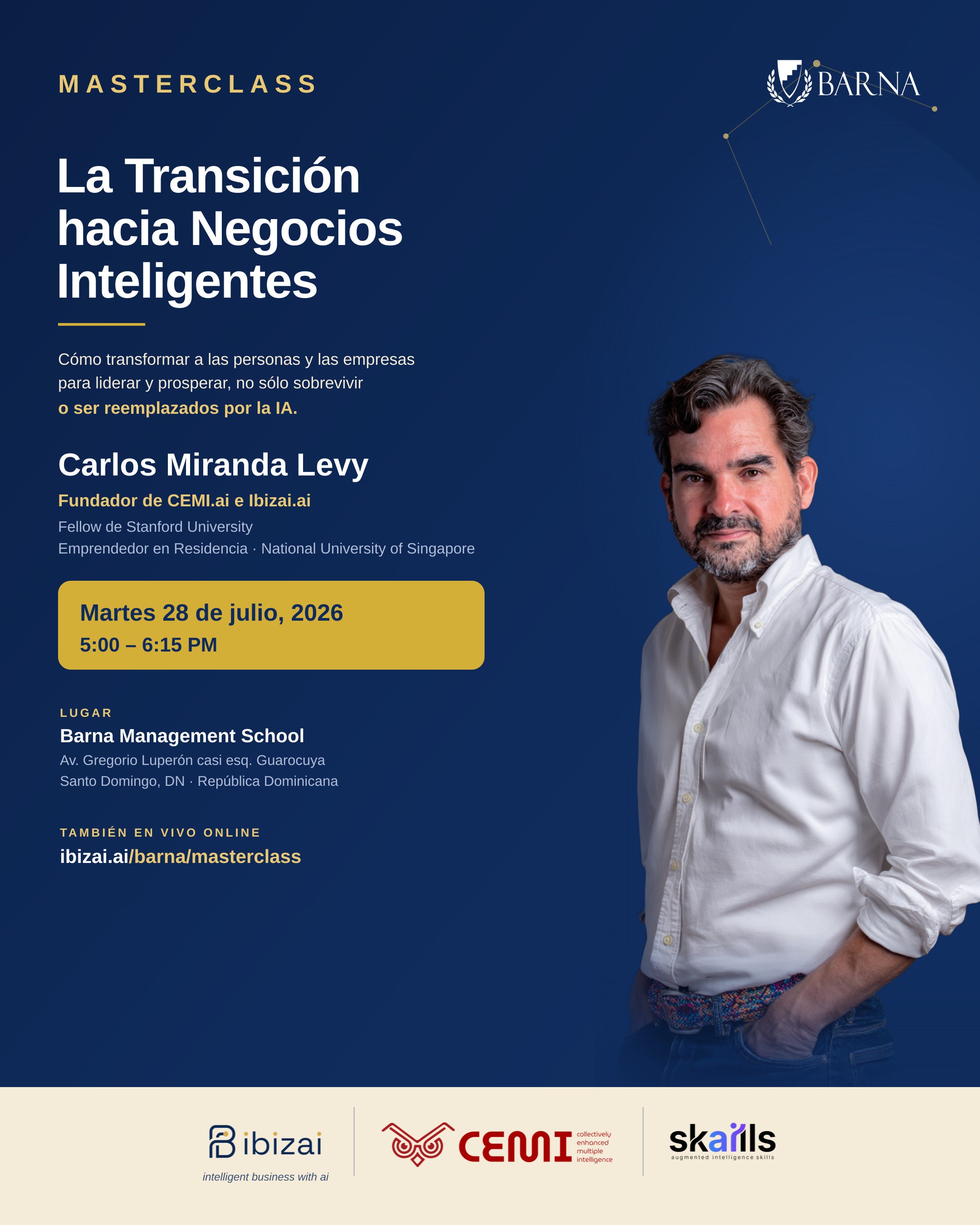
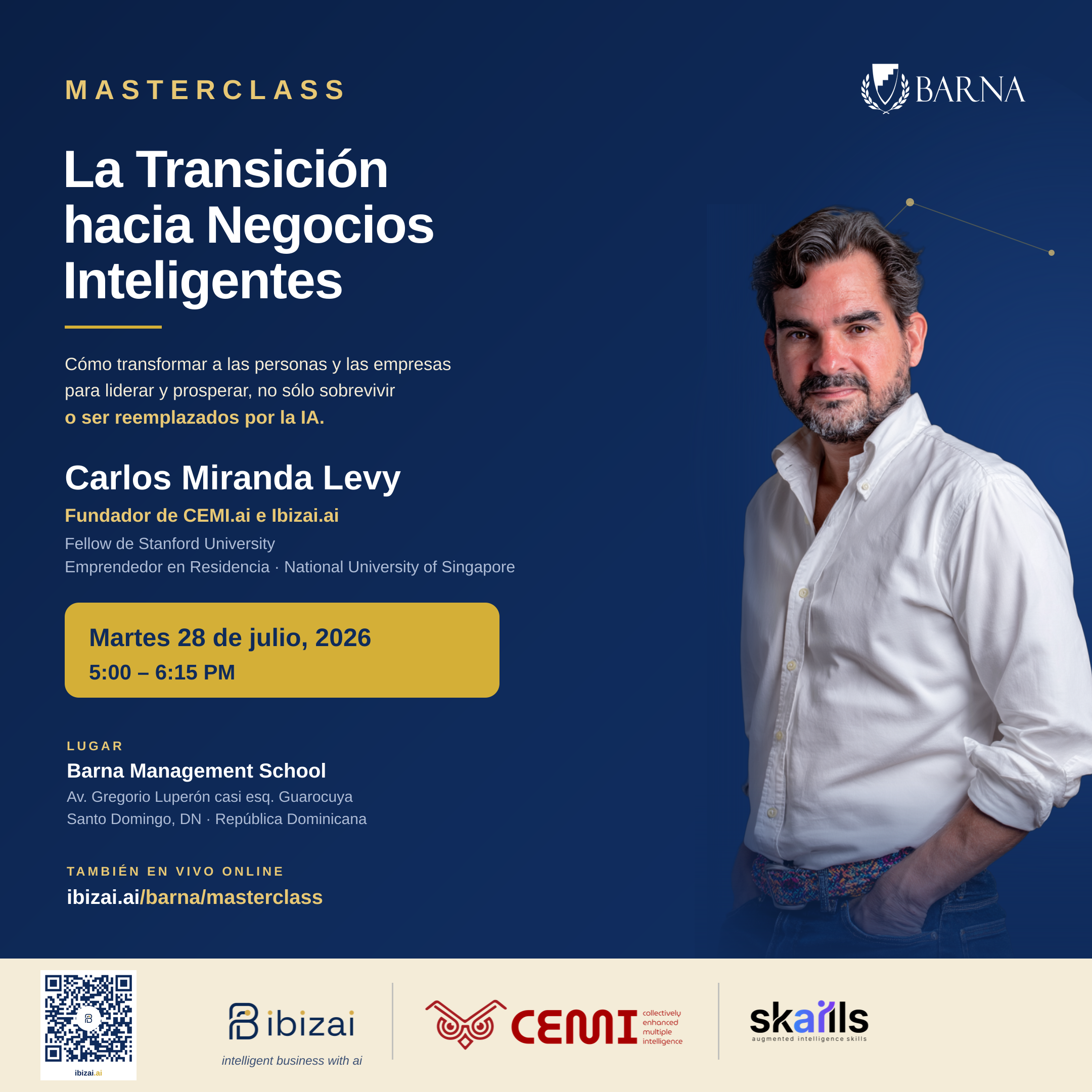
- Date: Tuesday, July 28, 2026 · 5:00 – 6:15 PM
- Venue: Barna Management School — Av. Gregorio Luperón near the corner of Guarocuya, Santo Domingo, DN, Dominican Republic (map)
- Also live online: ibizai.ai/barna/masterclass
- Format: 90-minute Masterclass (~60 min of presentation + conversation)
Included for participants
All attendees receive access to our AI readiness assessment tools — for companies, for executives and for professionals. Each participant can diagnose where they stand today and receive a concrete action plan (iBIZai assessments + professional skills on SKaiLLS).
Title
The Transition to Intelligent Business: how to transform people and companies to lead and thrive, not just survive or be replaced by AI
Alternative subtitles, by channel:
- Strategy, talent and competitive advantage in the era of Augmented Intelligence.
- What makes us different makes us better.
Long description (web / brochure · ~150 words)
Artificial intelligence is not doing one thing to work: it displaces, augments and reinvents at the same time — and the greatest risk is not in the destination, but in the transition we are living through now.
In this Masterclass, Carlos Miranda Levy — founder of CEMI.ai and creator of applied-AI frameworks across more than a dozen industries — starts from the honest evidence (all of it, not the convenient part) to answer the only question that matters: what do people and companies bring that the machine does not have?
We will walk through four parts — the world, the company, the professional and the practice — to show why augmenting beats automating and reinventing beats optimizing, how to build competitive advantage that can’t be bought, and — very concretely — how to work with AI as a partner: its three advantages, seven principles, five thinking styles and the warnings. With data, applicable frameworks, answers to the questions every company asks (including should we ban AI?) and one conviction: what makes us different makes us better.
Short description (agenda / social · ~50 words)
AI displaces, augments and reinvents work all at once. Carlos Miranda Levy (CEMI.ai) shows, with evidence and applicable frameworks, why augmenting beats automating — and how people and companies build an advantage that can’t be bought. A Masterclass on strategy, talent and competitive advantage in the era of Augmented Intelligence.
One line (invitation / email)
Lead and thrive, don’t be replaced by AI: how to transform people and companies for a world governed by AI. A Masterclass by Carlos Miranda Levy at Barna.
Learning objectives (what attendees take away)
By the end, participants will be able to:
- Read the transition honestly — distinguish where AI displaces, augments and reinvents, and why risk concentrates in the transition period.
- Defend an augment-first strategy with business evidence (productivity, institutional knowledge, 5-year NPV), not just ethical arguments.
- Identify their real competitive advantage — the context and judgment that generic AI does not bring (“what makes us different makes us better”).
- Redesign the entry ramp so as not to break the talent bench (the first-job crisis).
- Design a portfolio career — AI-proof skills, AI fluency and the T-shaped professional model.
- Leave with actions for Monday — concrete steps for the person and for the organization.
- Work with AI as a partner — apply the seven principles, direct its thinking style (chain, tree, devil’s advocate, Socratic…) and avoid the three mistakes: verification, over-delegation and loss of voice.
- Answer the governance questions — including should we ban AI? (answer: enablement with governance — training, your own solutions, local models).
Program content (modular)
- Opening — the blacksmith and the automobile; the right question (what do I bring that the machine does not have?).
- Part 1 · The world — the Transition of Intelligence: AI displaces, augments and reinvents all at once; the risk is in the transition.
- Part 2 · The company — augmenting as strategy; not the same thing cheaper, but more/different/better; the competitive clock; and the FAQ should we ban AI?.
- Part 3 · The professional — portfolio career, AI-proof skills, AI fluency, the T-shaped professional.
- Part 4 · AI as a partner — the 3 advantages, the 7 principles, the 5 thinking styles, the real case (3 h vs. 4 days) and the 3 warnings.
- Synthesis — Augmented Intelligence, the great leveling, the leader’s five verbs.
- Conversation / Q&A.
90-minute core; Part 4 can be delivered in full (~18 min), condensed (~8 min) or turned into a separate workshop.
Who is it for?
Executives, managers and transformation leaders; professionals who want to adapt their trajectory; and graduate students preparing for a labor market in full transition. No prior technical knowledge required.
Speaker bio (for Barna material)
Carlos Miranda Levy is founder of CEMI.ai, a global collective for human-AI collaboration in education, business, health, law, media and the arts. An expert in innovation, technology, education and social entrepreneurship with a thirty-year career spanning four continents, he is an economist by training and a technologist by vocation. He founded CIVILA in 1996 — one of Latin America’s first social networks — and was recognized by CNN in the year 2000 as one of the twenty most influential Internet leaders in the region. He has been a Digital Vision Fellow at Stanford University and a Social Entrepreneur in Residence at the National University of Singapore, and has received fellowships and awards from the Google, Gates and Reuters foundations, and from MIT, among others. His distinctive contribution is the creation of replicable frameworks for applied AI across more than a dozen industries. His motto: “What makes us different makes us better.”
Short bio (one line): Carlos Miranda Levy is founder of CEMI.ai, a global collective for human-AI collaboration in education, business, health, law, media and the arts.
Suggested tags / hashtags
#AugmentedIntelligence · #AIforBusiness · #FutureOfWork · #Barna · #CEMI · #AugmentDontReplace
Editions of this masterclass
Every time we deliver it, the session is recorded here with its venue and audience.
The Transition to Intelligent Business
Ninety minutes with executives, founders and managers, in Santo Domingo.
See the edition →Want this masterclass for your organization? How we run AI and innovation workshops.